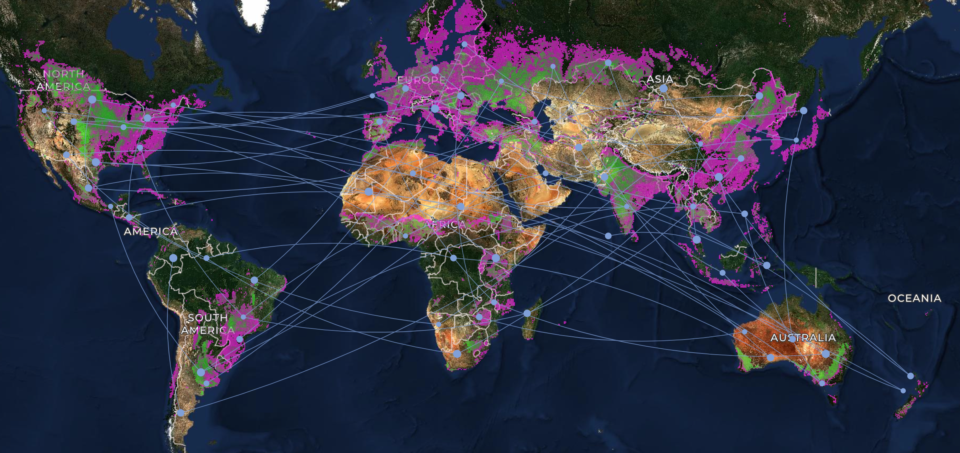
 Geospatial Innovation for Food Security
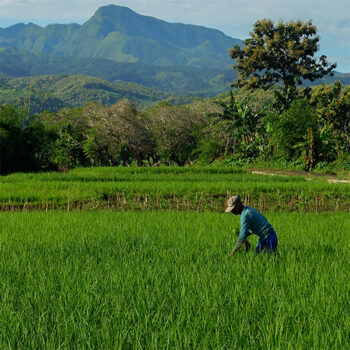
 Fields of The World
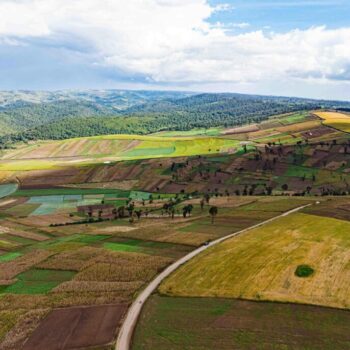
 Features of The World
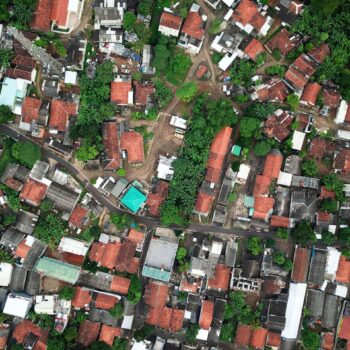
 Benchmarks of The World
Episode Description
What does it actually take to map every agricultural field on Earth? In this episode, Matt sits down with Jen Marcus, Vice President of Strategic Innovation Programs at Taylor Geospatial, and Isaac Corley, Director of AI/ML Research at Taylor Geospatial and a torchgeo maintainer, the team behind Fields of The World (FTW). In late April they released the first globally consistent dataset of agricultural field boundaries, at 10m resolution, fully open on Source Cooperative. They dive deep into how it came together, from building the fiboa format to standardize ground truth across 24 countries, to running model inference across the entire planet, to shipping it with a confidence layer instead of pretending it was perfect. You’ll hear honest perspective on what GeoAI can really do today and where the hype outpaces reality. In this episode, we cover:
- Why a global field boundary map had never been done, and why no single organization was positioned to do it
- The labeled-data problem and why models have to generalize to places like South America and Africa with little ground truth
- The fiboa format and Chris Holmes’s “architectures of participation”
- How the Technical Fellows program turned open-source contributors into the core team
- Running global inference efficiently with Sentinel-2 planting and harvest mosaics
- Cloud-native outputs (GeoParquet, PMTiles, Zarr) you can stream with no backend
- What’s real vs. what’s marketing in geospatial AI, and the ImageNet lesson
- What’s next: stakeholder feedback loops, higher-resolution imagery, and mapping new features beyond fields
Whether you build ML pipelines, work with satellite data, or you’ve ever wondered how much of the planet is still genuinely unmapped, this conversation breaks it down without the buzzwords.
Listen to or download this episode of the Spatial Stack podcast on Apple podcasts or Spotify.
Connect with the host Matt Forrest:
📸 Instagram: / matt_forrest
💼 LinkedIn: / mbforr
📧 Newsletter: https://forrest.nyc
🌐 Website: https://forrest.nyc
Edited for brevity and clarity.
Matt Forrest: Today, I’m sitting down with Jen Marcus and Isaac Corley from Taylor Geospatial, the team behind Fields of the World. In late April, they released the first global map of every agricultural field on Earth. If you work with satellite imagery, build machine learning models, or you’ve ever wondered why something this basic has never been done before, this conversation is for you.
We get into what it actually takes to do this at a global scale, the label data problem, the fiboa format to standardize ground truth from 24 countries, running inference across the whole planet, and the constant tension between what AI can really do and what’s just marketing.
This is the Spatial Stack, and as always, the future is spatial, so let’s get into it. Jen and Isaac, welcome. I’m excited to talk today, learn a little bit more about Fields of the World, which is one of the more interesting projects that I’ve seen kind of take place in all things geospatial. But I think it’s definitely something that has drawn a lot of interest. What drove this and how are you working on taking this forward from there?
But before we jump in, if you both wanted to give a quick intro of who you are?
Jennifer Marcus: Super. Thanks for having us. We’re grateful for your interest and kind words at the beginning there. I’m Jen Marcus. I’m the Vice President for Strategic Innovation Programs at Taylor Geospatial.
Isaac Corley: Hey, Matt. Great to be back. Thanks for having us. I’m Isaac, Director of [AI/ML] Research at Taylor Geospatial, and I joined about halfway through [Fields of The World]. So Jen definitely can talk more about the inception of all of this, but I helped get it across the finish line to help train the final models and actually do the global inference run and publish everything. So yeah, happy to be here.
Matt Forrest: Yeah, we talked a lot last time around and I think what’s interesting is, you know, everything in geospatial is starting to get bigger, right? We’re looking at doing things with more data, looking at global phenomena, even into some of the models and embeddings and things like that. But what I think is particularly interesting is you took a very specific problem, right? Understanding the agricultural landscape of the world and simply mapping it, which is something that, as far as I know, has been talked about, or at least explored, but never completed, at least to this degree. So I wanted to understand, and just start at the beginning, why did you pick this problem? What were the motivating factors that went into that, and more importantly, why has this never been done before?
Jennifer Marcus: That’s a lot there. That could cover this whole time period! There’s a number of whys, but the most general why, and we have to step back a little bit. It’s not actually about field boundaries per se. It’s about the massive amount of satellite imagery that has come to exist in the last decade. Will Marshall, who’s a co-founder of Planet Labs, in 2014 said, If you had a daily scan of the Earth, what would you do with that?
I spent a lot of my career focused on the national security defense and intelligence customer. The National Geospatial Intelligence Agency said: We want a daily take. That’s what we want. That’s what we need. A picture everywhere on Earth, every day. In 2017, Planet made that happen. Since then, this whole industry with the lowering costs of launch and the minimization of satellites, we have the daily take of the Earth and then some every day.
It became very clear to me that in the expense and the fundraising of launching that many satellites and getting that much into space, something was missing. We kind of jumped over the concept of: It’s not the data collector in space we want. It’s the insights that are held in all that imagery that we want. It’s a lot of work to get that out, to have the machines tell us what’s captured in all that imagery. So, I also saw that a lot of people were working on small parts of this and the repetitive work on small parts of pulling features out of satellite imagery meant that we weren’t getting an effort to pull something out at global scale that everyone could use and move on to their actual special use case or their special analysis.
Where the opportunity came from is that we have a philanthropist, Andy Taylor, who got excited about geospatial and was willing to fund this organization to do this work, to increase the innovation capacity. So, we were able to ask ourselves, what could we contribute to our field? Pun, actually, not intended there. But we had the great opportunity to think about it, not from a for-profit, fundraising, or could we IPO? But from a nonprofit standpoint, what could we do to take this geospatial field that I’ve known and loved my entire adult life and move it forward so that the promise of all that information held in imagery could be unlocked and made available to solve some really massive questions of our time?
Matt Forrest: Yeah, a lot has been driven by the data and I think just the sheer amount of data that we’ve been able to collect and it just keeps going up every year. You hear we have more data, better data, better granularity. We have more and more things that we can do with that. But really taking something out of it and extracting that from any different angle that you want–so much of that seems to be on very local scales or smaller scales. You can do that for a very specific area, be that even just a part of a region or small scales like that.
How do you take that problem and then start to go to that global level scale, and what does the data that goes into that look like? Because I imagine it can’t be, you mentioned a daily scan of the Earth, right? You probably need a lot of scans of the Earth to get a consistent picture of these areas. Also, how do you account for things like change and stuff like that? When you started to map out this project, what are some of the big considerations that you had to start to really understand before you got into this, to understand what this means to do this at global scale and differences in fields and boundaries and all these different pieces? What went into some of that thinking even before starting to go down this road?
Jennifer Marcus: I can answer some of that from a people and organizational standpoint, and I can let Isaac address it from a technical perspective. We knew from the beginning that we wanted to tackle a problem that was bigger than any one organization could do. In fact, it’s the same, it’s the flip side of what I talked about before. If you’re going to do something at global scale, it requires collaboration, and the reason it doesn’t already exist is because no one organization is incentivized or positioned to do it. So we thought if we could create an ecosystem of–one of my collaborators from the beginning on this is Chris Holmes, he calls them “architectures of participation”–how could we think about this problem in a way that opens it up to have contributions from many organizations contributing their strengths so that we’re not replicating strengths or things that people have already solved? How could we formulate projects or a project approach or build a community to do that? What that’s resulted in is this ecosystem of capabilities that we’ve created. Isaac, I’ll let you talk about that part, the technical part.
Isaac Corley: Yeah, I think it goes back to machine learning 101 or at least geospatial machine learning 101 and the ability to generalize. So, the reason why things are very local is because they only have the labels for areas people care about, and everyone doesn’t work together to do this on a global scale. So, somebody has to be the first one that goes and collects all the label data sets and works with partners and organizations to not only collect them, but get them in the right format.
So, once you have all the data, we had to create the new fiboa format so that we can all agree on some kind of schema, even if it’s very minimal, that we can have people transform into fiboa format, and then we can just aggregate all that and create machine learning data sets that we can train models on. Then we have to do all these experiments in evals. So it really is like almost agnostic of the model itself, and it almost goes back to just the basics of everything is spatially autocorrelated, so we want things to generalize because we don’t have labeled data for the entire Earth. That’s the number one problem.
So, we’re having to get data sets from very specific areas and hope that they generalize or work and find out tips and tricks that we can do to make it generalize to areas like South America, Africa, where there’s not a lot of labeled data for that. Then once you have that, you have to run it at scale, and there’s so many parameters just to get it running at scale and to make it work across the globe. People don’t consider that outside of: I train my model. Now what? There’s all these other parameters and knobs you have to tune just to do global inference. So, we had to spend a lot of time on that, not considering post-processing. I think there’s a lot of work that has to go into this entire pipeline and somebody had to end up doing it eventually.
I always go back to, I always say this is very much a, “If you build it, they will come” situation. Nobody is actually getting together and organizing and contributing. But now that we put it out there, we already know it’s not perfect. There are some areas that are not amazing that we don’t have labeled data in. We put out a paper and produced a confidence layer because we don’t have ground truth to even compare to tell people when they ask, “How well does it do in smallholder fields in Rwanda?” or something. We don’t have ground truth for that. So, we have to make some assumptions and some estimates to give people confidence in what they can depend on what they can’t. But yeah, we’ve been swarmed with the amount of people now that want to contribute and add label data to it just because we put it out there first. So, I think that’s a big part of it–that is the mission of Taylor Geospatial. Someone has to lead the charge to get everyone on the hype train to start contributing, and that’s really what we’ve done.
Matt Forrest: Yeah, walk me through that process as well. Like when you’ve picked a problem and you’re going to start solving it. First of all, how did that work from getting people involved? Was that you finding them? Was it creating the spec? And I do want to talk a little bit about fiboa because I don’t want to skip over explaining what that is to folks listening so they can kind of understand what that plays into it. Because it sounds like there’s this whole organizational participation layer of just getting people to come to the table and start talking about it first. Then you have to give them a way to consistently contribute data in a way that’s useful and well formatted and structured.
Then from there, how do you take that and actually say, okay, well now we have a model. How do you actually technically scale that from just on your computer to actually running a complete process to make that work, which is a different engineering process. It seems like there’s multiple layers of like design here from participation to schemas and data collection all the way through to ML ops at scale. So tell me, start at the beginning and kind of say, okay, here’s who came to the table, here’s how we got people involved, here’s how we decided on a specification, and here’s how we actually made this thing run, right? How did you do all three of those pieces?
Jennifer Marcus: Yeah, this is where the magic is. I still to this day am dazzled by how this went. Chris Holmes and Jed Sundwall and I… so I was charged with: Figure out a way to kind of migrate academic research and geospatial on the cutting edge into commercial impact or that has the potential for commercial impact, get it closer to commercializable. I knew that from previous work that I had done, I knew that what I saw in academic labs was great work that was, from the words of it, massively relevant to what industry needs. But when I looked at it closer, being a person who’d always been on the industry side and the customer facing side, I did not know what I was looking at. I couldn’t take it and make a map or do something because it just was done for academic purpose in a paper. And the incentives there were for papers to be published. And sometimes you have a requirement for it to be replicated, but not replicated at scale, not done in formats that people could take and run with.
So, we knew there was a gap that we wanted to bridge between cutting edge academic innovation and usability by a broad community. So, what we did was we gathered a group of people, basically a coalition of the willing, and invited them to St. Louis, had a meeting, said: Here’s this thing we think we’re going to do, what we want to create. We had already decided field boundaries was a good place to be because it was global, has tons of use cases, has a lot of climate impact that can be asked and things like that. Plus AgTech, there’s also a lot of commercial capabilities that are looking at agriculture. So, that was sort of easy for us as a starting point. Jed, Chris, and I sat down and thought of everyone we knew who might have an interest and might want to work with us. We really did not know what we wanted to ask them to do or how to ask them to do it, but we knew that we were going to–and I keep saying this, I hope it’s okay if your channel is a little PG-13–but our mantra was: Get sh** done. The first meeting we had was not going to be a meeting where we talked about what we wanted to do in the future. We sort of interwove talking about it with, let’s just sit down and scrap it out. Let’s see what we could walk away with. So fiboa was actually from that first meeting of, what if we were to try to bring data sets, ground truth data from all over the world, from different governments, from people who’d driven by with GPS on their mopeds and put that all into one place so we could use it as training data? What would this common spec need to be?
You know, I was constantly saying, we’re not doing specifications. That’s not what we’re here to do. We’re doing something to enable us to bring a bunch of data together and eventually create a global data set. So, we sort of drove for the minimal, most basic features and attributes you would need in this to bring field boundary data sets together, and we’ll make it extensible so when we got it wrong, you can fix it later. We ended up because of that, you know, about half the people who joined us. I think we had 20 plus people that first time, from all over the world. About half of them walked away with a way they could continue to contribute and kind of excited about the approach. Over time, we awarded grants to the research teams. We had this idea of having technical fellows who would run alongside the research teams and say, hey, if you put that data in this format, then other people could use it right away. If we store it on Source Cooperative, then people can find it.
So, we sort of started drawing–and this is how we met Isaac–people who wanted to work like that, who were working in the open. I don’t think we’ve said this explicitly in this call, but everything we do, we’re publishing as open source in every piece of the ecosystem. So, you find these incredible, incredibly talented people who are working on the side because they’re motivated by this kind of work and their friends are doing it. So, we end up with people that are contributing. I was saying to our team, there’s people we don’t know putting code in there, guys. Like, what do we do? How do we get them out of there? And they’re like, no, no, that’s what we want. We know them! They are highly qualified people. So we ended up, kind of after the fact, creating this program called the Technical Fellows Program. I’m like, if they’re good, I’ll pay them a stipend to keep them around and keep them motivated. So that just grew and kind of shook out to be the research teams and the technical fellow teams. Then we had some infrastructure partners who were doing the storage and dissemination, Wherobots doing the scale up of infrastructure. So, we had partners also that were our scaling partners, really, come along when we needed to do that.
Matt Forrest:
Yeah. Then once you get to that point, when you brought these people together and you’re obviously getting data contributions, you’re getting code contributions, you’re getting sort of this critical mass going from that perspective. Now you’re faced with the challenge of actually running this thing and getting the global data produced. What does that look like? Because, you know, again, you mentioned that there’s incredible research that’s going on from the academic side producing very good models. You’re now sitting on top of this collection of ground truth data and data sources that can be used. It’s out there, it’s in the open. I’ve used it, I’ve seen it sitting on Source Cooperative, I’ve seen it. How do you go from that to now this final output that you produce, both the map, the data set, everything from there to help that scale from the technical side? Because I think that’s one thing that I’ve seen. You can go on online and you can find incredible models that people have published or papers, things that are sitting on GitHub that look very cool. I’ve even seen great global data sets be produced and they’re sitting on a Google Drive and just kind of, you can get them, they’re there. So how did you go to build that with both the engineering design in mind and then also the ability to make this useful for all the other people downstream that want to use it? What did that kind of process look like?
Jennifer Marcus: I want to say one thing and then I want to hand it to Isaac for the technical side of it. But I think that we were relentless about our North Star, which was, can we do this at global scale? Can we do it? I asked myself the question over this time period of like, should we be doing this? Like a couple of times I called Chris Holmes and I was like, what are we doing? Like nobody thinks this is a good idea. But we kept insisting, no, it is because we’re going to do it at global scale and then local scale will try use cases and we’ll try it out and they’ll tell us what they like about it and we feed that back into the global scale. So I think just the insistence on that as an end state and our comfort with it not being perfect. Our comfort with our goal is to see if we can do it. And in that sometimes you can’t. And we found out there’s places that need improvement and we’re okay with that. So Isaac, I’ll let you talk about this from the technical standpoint.
Isaac Corley: Yeah, I agree with Jen. I think a lot of people will get analysis paralysis and they won’t publish something because they think it’s not perfect or that there’s flaws. And I think definitely understanding what the long term goal is outside of criticism is really important. Like being okay with the criticism and already knowing in advance, like, what, what works and what doesn’t is super important. I’m unfortunately immune to criticism just by being in academia and publishing and having very rude reviews publicly online. But yeah, I think the big thing is like, like as you mentioned, Matt, you can find countless models online, right? I think actually we had a good partner in Caleb and Hannah who were mostly training like U-NETs and trying to find out what is the simplest model we can do, not just the fanciest model and that gets us an extra couple IOU percentage points. So, we already came in with a model that was already pretty efficient and is pretty well thought out–how would I run this on a full Sentinel 2 tile?
So, really we just had to scale that up. I think the biggest complexity of our model was definitely because agriculture is very temporal oriented, we had to feed in a planting and a harvest season mosaic stack to the model just to get that contrast of planting versus harvest season, what the field looks like. But yeah, I think all of that requires–and that’s why shout out to Wherobots and the Rasterflow team–because there’s a lot of tuning and getting the mosaics right and efficient at scale because there’s a lot of ways to do it wrong. It takes a lot of engineering effort and experience and just the tenacity to keep trying to tune and get that extra bit of performance out. It takes a lot of effort on that side. But once we had got it connected and figured out, we were able to run it at a very efficient cost compared to Google Earth Engine or if we just ran it on single node, or whatnot, it would take forever. And I think that was important because we ended up doing multiple runs. It wasn’t like a single run. We had done a bunch of country scale inference like in our proof paper that’s at CVPR. We had released five country scale field boundary data sets for two years before we even did it global scale. So then releasing it, you know, we used a lot of the hottest new tools like Zarr and GeoParquet and PMTiles. And I think having that expertise from engineers at Wherobots definitely helped us rely on being able to ask questions about: what is the best format, what chunking and sharding should I use and how do I make this efficient? Because our goal was to get it in Source Cooperative in cloud native formats so that we are not required to have a backend. People can simply just stream it from cloud storage for whatever front end or application they want to use it for. We didn’t want to be yet another API that’s rate limiting everybody. And so thinking about all these things outside of just training the model and getting the model checkpoint and the benchmark data set out there, I think in academia, a lot of times that’s where the incentivization structure cuts you off and taking it that last mile to get it to a product, even if it’s not perfect, like getting it out there into the hands of people. We’ve just seen so many people with so many applications. I think someone was using it for a golf simulator game that they’re building. Yeah, it’s literally insane what people are using it for and we’re here for it.
Matt Forrest: It’s funny that you say that. I mean, you both said we want to get it out there and get people reacting to it, interacting with it and just seeing it. Despite the fact that it may not be 100% perfect in all areas. There’s a certain amount of thick skin you have to build up to be able to say, okay, there’s going to be feedback and stuff like that. Usually what I find is that the positive aspects of that generally outweigh the, “well, this wasn’t right, so it’s not perfec”t type of thing. And I’m sure you’re seeing that from how people are even just using the data now or being able to interact with it and contribute to it. I think there’s something interesting in that, and I want to get into what the future looks like maybe a little bit as we start to go through this discussion.
One thing I did want to dig into a little bit more as well was just understanding the really key parts that came together to solve this on a global scale. And I think that’s one thing that’s probably the most impactful and and one thing that you know, maybe not a lot of folks understand. You know, people in the public, I think generally think that most things have been mapped, right? You have Google Maps and I can go anywhere in the world and click here and see these things. And while that may be true, and we know that there’s certain limits in different areas and stuff, and we’re still working on that for things maybe like roads or cities and some things like that. But even stuff like buildings and obviously fields, but you’re solving that now. Why does that specifically matter? And what does that look like kind of having solved this at least once or gone through this process. What are other things this opens up to start to explore, to map at a global level?
Jennifer Marcus: Yeah, there’s a lot there. The component pieces that came together are the benchmark data set. Then we did a whole series of model evaluations and model tweaking to get the best results. And then there’s running it at scale, the infrastructure to do that, which is more commoditized. And then publishing it out on Source Cooperative, again, that’s riding on AWS. So, we really focused on not having any ownership over things that somebody else was building a business around. And I’ve seen that a lot in my career is people set out to do one thing and then they’re like, well, we should probably do this thing too and this thing too, but we’re not really experts in that thing. So, we just focused on the pieces that needed to be moved forward. And you said something that really resonated with me, and that was that I could see this hype cycle going to where no one knew anymore what is actually what, what the AI and satellite imagery, AI writ large is actually capable of and what is kind of marketing speak.
I talked to some very senior government people who would tell me–and research people–this was what I found interesting. One researcher who still works with us, I was talking to him about, are you interested in doing global data sets? And he was like, yeah, but you know, they’ve already done that. I’m like, who? And he lists, you know, the usual suspects in our industry. And I said, how do you know? And he said, well, it’s on their website. And I’m like, dude, that’s your market research? Like that’s marketing. That’s not real. It means you could do that if you paid them a hundred million dollars. So I was like, there’s really something here.
There’s a lot of organizations who have a motivation to market either their cloud storage or their scaling things at, or running models at scale, but they don’t even have something to do that. They’re doing that on “maybe someday we’ll…” And the other thing was–I need to go check because I’ve been talking about this recently–but Chris Holmes and I typed into ChatGPT when we were getting this started, “How many farm fields are in Kansas?” I’m from Kansas. And it said, I don’t know. It said, you could call the Kansas Land Bureau. There’s this organization. You know, so I’m like, we need to get this realm ready for the other capabilities that aren’t in geospatial that are advancing like crazy. And also I had read, listened to, actually, Fei-Fei Li’s book about her career, but about the creation of ImageNet. There were a lot of times that there was doubt and no one thought it was worth anything and it wasn’t the right thing to do. And eventually it grew to where it was. And so that sort of helped me because I’m like, well, she just got awarded, I don’t know what it was, $250 million to run a company, but she spent 10, 15 years in this realm of holding onto her North Star. So Isaac, you take it from there.
Isaac Corley: Yeah, it’s great that you bring up ImageNet and Fei Fei Li because I always think of Fields of the World as like, sometimes I’m like, is this an agricultural foundation model? But yeah, I think there’s a lot that goes into it, but I would love to have Jen just kind of talk a little bit more about the outlook of what Features of the World is going to be. Because I think setting all this up was a really hard task, but then we need to go into the next step of, we did all this experimentation of how to get the pipeline right and how to get that formula right. And we’re planning to apply it to other things. I think one misconception people have is like, oh, Taylor Geospatial is an agricultural research shop. It’s like, no, this is just one piece of the larger scheme that we have that we’re wanting to go into. So I’d love to spend some more time on just that.
Matt Forrest: Yeah, I think that’s really important is that, yes, problem one was agriculture, right? It provided a good framework to go to this, that, and for, I understand it because I kind of work in this space, but like, if someone’s thinking, why do you want to… Why fields? Why farms? What does that mean? Well, I mean, there’s obviously the social implications that you mentioned, the climate implications, all these things. But from a pure challenge, I mean, the collaboration of collecting, you said ground truth data from many different countries and getting that in is one piece. But they also look very different in different places. And that’s something I understood, is that a farm in Iowa is going to look way different than a farm in Brazil versus a farm in… Africa or any other place. They’re just fundamentally different in terms of how they look, their seasonality, there’s different harvest seasons depending on what part of the globe you’re in, different crops that are grown. Not to mention all the other fun things that come with satellite images like cloud cover. Mapping in Brazil is very difficult because there’s a lot of clouds there. You just have to deal with all these different pieces.
But then there’s the organizational piece that I think is really a cool framework to say, okay, how do you take that forward to apply this to the next challenge. You went into it not knowing how it would all come together. And I think those are some of the most fruitful ventures to actually come forward to actually say, okay, how do we bring people together and do things like this? And that’s going to show you, okay, here’s the elements we need, and it might look a little different the next time around, but you’re able to do all those different pieces and bring that together. So I guess the big question or two questions that might be are, number one, what does that look like for Fields of The World? What are the next iterations of that going forward? And then how do you plan to apply all the stuff you learned from fields of the world, the entire process part one, into future problems? Because I think that’s also interesting to say, what else is out there that you can start to explore? And now that you’ve done it once, obviously you’re starting from a place further than you were before. How is that going to take forward and solve the next big problem that you need to solve?
Jennifer Marcus: Yeah. So I’ll start with Fields. We knew from the beginning that we wanted to have the voice of people who would be potential future users in the mix, and we were able to do that with the fiboa spec and some other things. But where we were as an organization at that time wasn’t established enough to really manage what we call stakeholders in the mix throughout. With the current organization that we just established in January, we are now in a position to do that.
So with Fields of The World, there’s two things that are going to happen. One is us really working hand in hand with a handful of interested users to really understand whether their purview is global or their purview is local. We’re going to work with those communities and understand how this could be made better for them and really focus on a feedback loop that gets better data on the output or on ground truth side and have some automation to loop that in to improve what the model spits out. So essentially working with stakeholders is next. Then we’re also going to expand the benchmark data set. We’re going to look at higher resolution imagery and look at how that affects plus or minus to the outputs. So taking that whole end to end and really looking at everywhere we could make it better along the way is next for field boundaries.
The other thing we’re want to do is say, okay, we know what all the pieces and parts are, and this is why this problem set to me was a good one from the beginning, ’cause I was asking again, that same researcher that got ideas from websites, you know, marketing websites, was if you do one global data set or another global data set, is there a series of problems, technical approaches in there that are the same across all of them? And he was like, oh yeah. From the beginning also, we wanted this to be componentized and the architectures of participation so that we could then say, is the effort to then say, well, now I don’t want a field, I want a building globally. So right now we’re in the process of identifying what feature or features should that be that we tackle next. And we already kind of have some rough ideas of where to go, but looking at what we could do that would be in about the same timeframe we’ve just done and in high impact. So that’s where we’re going to take those things.
The other piece that we’re going to do, which kind of goes back to, and Isaac has thought a lot about this, but it goes back to: What’s real and what’s hype? So we’re going to do some work on benchmarking. It’s not sexy, but it’s a thing that we can offer, to do a real analysis of what can you do globally or what can you do for a certain use case, and what’s the best way to do it? Because one of the things that we really want as an outcome of our organization is that the research is going where the problems are, rather than people having to guess.
Matt Forrest: Yeah, I’m curious to see how this goes forward in the future. There’s a lot of things that can continue to make it more accurate, I guess you could say, and more useful. I think you’re already starting to see that, I believe, from people providing feedback and stuff like that. And that’s one of the great things about getting something out there and letting people react to it is that you’re already getting more feedback there, but then you’re even more set up for next time to make this successful in terms of knowing all the pieces you need to bring together to do that.
I think what’s most interesting to me is that it’s solving one of those problems that maybe people weren’t fully aware of. Just in terms of impact, I put together a short video about this and published it out on social media. Between the two channels that I’m tracking, I think it’s been viewed 1.8 million times. just people are really interested in this stuff. They’re not aware that these things are happening, and I think that they need to kind of see that and understand that. And I think that’s really where the cool work is happening, that you’re able to really see the full view of the problem and actually make it happen and make something come out of it. I think there’s a lot to be said about that, which is really great. So I’m excited to see what comes next and stuff like that, both from fields and from future problems.
Something that has always been a true component in anything in geography has been exploring what is maybe unknown, and this is certainly one of those things. And it may not be, you’re going to the Arctic Circle, but I think you’re doing some of the work in the same vein that is solving these problems that we don’t know about our planet, and I think that’s one of the coolest things about all of this. And I think that’s what people get excited about and want to get behind.
As we wrap up here, any final thoughts on some of the work that you’re doing, things going forward? Or more importantly, how can people that may be listening to this for the first time find out about fields, use the data, and get involved if they want to? How can they do that?
Jennifer Marcus: Well, first off, thank you for having us and for your excitement about this because that means the world to us. Secondly, we are just beyond fortunate to be able to do this. I get chills thinking about it. We’ve been beyond fortunate about people like Isaac who’ve come and joined us, and we were lucky enough to be able to hire Isaac because of the good work he was doing and the alignment. I actually think that’s–as much hard work as all of this is and very sophisticated, you know, PhD level work–it’s also, there’s magic in the people and in the way we work together and we’re going to see how to scale that. You know, how can we keep, um, keep the magic and not stifle it. But we’re so grateful for Taylor Geospatial giving us this platform to be able to solve these problems and do the hard work. So we’re really just beyond grateful.
Isaac Corley: Yeah, I think shout out to like the open source geospatial community because if you look at all the tech fellows we have and a lot of the contributors to some of our GitHub repositories, it’s pretty much entirely dominated by those who have been in the open source geospatial scene for a long time. We’re very happy to be able to fund them to work on fun stuff and like global scale. I think there’s definitely an excitement that they get about being a part of something that allows them to, you know, put something global that, you know, as you mentioned, a lot of people would assume, oh, it’s 2026, like we’ve definitely mapped every field that’s ever existed, right? And the answer is no. And so we get compared a lot recently to like, we’re like the Open Street Map of field boundaries where, you know, people are, you know, we’re building an annotation tool where people can edit, you know, fields that they feel like are not well represented or they’re missing in our data set. And over time, I think there can be this, this growth potential that will have an even better understanding of our, our world and our Earth and for food security and all the different aspects that in agricultural applications, but also change, like how has it changed over time? Because there is a lot of change and we’ve had a lot of people reach out about that as well.
Yeah, shout out to the open source geospatial community. Shout out the Rasterflow team at Wherpbots for all the support. Hannah Kerner’s lab, Nathan Jacobs’ lab, everybody who spent time training models and trying to get the best performance out of the models. That was a lot of effort and we sat in a lot of meetings and I had to crowd everyone to get on the same page a lot of times. But I think we, as Jen mentioned, we always had this like North Star and everyone on the team was pushing towards like, let’s get something that can work and scale and put it out there. And it doesn’t just disappear into the black hole of archive papers over time.
Jennifer Marcus: Yeah, I want to add that the researchers who were willing to work in this way They took a leap because we said, we don’t exactly know how we’re going to do this. And so they were willing to expose themselves to that. And it’s really worked out well. The two things I’d like to kind of plug while we’re here are that one, we have a postdoc position open that Caleb Robinson put out on LinkedIn. So it’s a postdoc that we’re funding that will be hosted at Washington University in St. Louis and directed by Caleb from the Microsoft AI for Good Lab. So we’ve seen a lot of really good candidates already, but if there’s anybody listening to this, then you are probably a good candidate and you should reach out. And then the other thing is If you’re interested, if you’re in the open source community as a developer and interested in joining us, we do have the Tech Fellows program and we would love to talk because we need more help along that route.
Last thing I’ll say is next time you’re on an airplane, sit by the window and look out. I’m in the Midwest, so every time I fly, I’m flying in the space where I can see the ground and see fields. And I was like, what’s so hard about this? I mean, you can see them, you can see the outline, but if you really look, you’re like, oh, well, I don’t know exactly what the boundary of that field is. So your own brain can’t do it. It’s hard to get the computers to do it. So that was a fun exercise for me when I was like, oh, I can’t segment that exactly, right? So look out the airplane and see what the world has to show you.
Matt Forrest: Yeah, well, it’s certainly, I think, taking that, looking at other things and just understanding how you understand the world and understanding now this deep process that goes into actually doing these things. Hopefully that connects you to help understand what a monumental feat this was. So Jen, Isaac, thank you again for taking the time to join me. If you’re watching this, I’ll put all the relevant links in the description. Or if you’re listening to this, it’ll be in the show notes on wherever you’re listening to this on, But thank you both. I can definitely say I’m excited to see what is coming next. And I’m sure we’ll be hearing more from both of you and Taylor Geospatial in the future. So thanks for taking the time and we’ll talk soon.